Episode Transcript
[00:00:00] Speaker A: Hi, Kayla here. And the question I've been examining this week is this.
What if the safest love available to me wasn't even human? You see, in this episode of Imperfectly Honest, Elizabeth sits down with Sheila Lamont to explore a question that feels not only timely, but deeply personal.
Can AI replace, or maybe a better word is supplement, romantic connection?
From fact checking dinner table debates to outsourcing laundry and other household tasks, emotional support, and even intimacy, the pair examine that seductive promise of partnership without risk.
But if love comes without the possibility of rejection, compromise, or heartbreak, are we actually losing the very thing that makes it meaningful in the first place?
Together, Elizabeth and Sheila unpack safety versus growth, certainty versus choice, and whether the discomfort of human connection might actually be the whole point.
So does it sound too good to be true or maybe just too far fetched to be considered? I don't know. I'm still thinking about my answer and invite you to find yours. So, without further ado, on to the
[00:01:21] Speaker B: episode, this isn't Perfectly Honest.
I'm Elizabeth, and after about four decades, I'm shifting from the person I always thought I should be to the person I really want to be, in part because I've learned to be honest both with myself and just about everybody I encounter. It's not always perfect. Sometimes it's a rocky road. But I'm learning a lot by being imperfectly honest and thought you might learn something too.
Hey, y', all, back again with my friend Sheila Lamont.
Hi, Sheila. Thanks for being here.
[00:01:58] Speaker C: Oh, my pleasure. Thanks for having me.
[00:02:01] Speaker B: So Sheila and I have been tossing around a couple discussion topics, and she mentioned some articles that she had come across about the question of whether AI can replace or supplement romantic relationships and just in person connection. And that got my wheels turning about many topics, but thought it might make sense to talk a little bit about a quote, which is that romance without risk is a seductive promise, but if we take away the risk, do we also lose the very thing that makes love real?
And that quote spoke to me because I've been thinking a lot about the risks involved in loving someone and the risks involved with putting yourself out there in the dating world.
And I have come to the conclusion that it's virtually impossible to find love without being hurt at some point in your life.
The idea that you could build a partner that would not hurt you is appealing on the surface, but I think when you dig in more, that risk of hurt might be essential.
So Sheila would love to hear a few more of the thoughts that came in your mind and See where the conversation takes us.
[00:03:40] Speaker C: Well, just to address that quote, which actually was contained in one of the articles I sent you about AI and romantic relationships.
I agree with you when you say that how can romantic relationships come without risk? I mean, how can any relationship come without some kind of a risk?
We need to sometimes define the risk. Is it that? And you said hurt. So we're afraid they're going to hurt us. And of course, in especially romantic relationships, we're afraid it's not going to last.
And so then do we just avoid them because they're maybe hurt or they're not going to last? And of course, I vote, like you, I know, don't avoid them. The only cautionary thing is feeling as if it's essential throughout any romantic relationship that there's always risk. I mean, there's always risk that people will die. I mean, that that risk you cannot eliminate. I mean, that's just a fact of life.
But the, the risk that it will break up or that they will hurt you is always present. But I think it helps in terms of choosing a partner where you get to a place of trust, where it's minimized.
It's not something you have to live with all the time.
I guess that risk part of it is, when I'm reading this quote, I'm kind of leaning in that direction. Yeah, it's there, it's a risk, but I don't think it should be an overwhelming risk.
[00:05:35] Speaker B: Well, I've been thinking a lot about our last podcast conversation about whether we are default yes or default no people, and you brought up the astute point that maybe there's a default maybe, and that maybe that's who we both were.
And I think that that's right. However, I think I want to shift to being more of a default yes person by simply asking the question of how might my answer be yes first, rather than asking why I should say no first, which is typically my reaction.
And when I think about this subject, I think the reasons why I would say yes first are that having the opportunity to design the perfect companion for you would be extraordinary. And having the opportunity to program it to do things that you don't want to do that would complement you also would be extraordinary.
And we may not have to give that up in order to embrace the human connection.
So I was thinking about a scenario in which I was sitting at a table with my human partner.
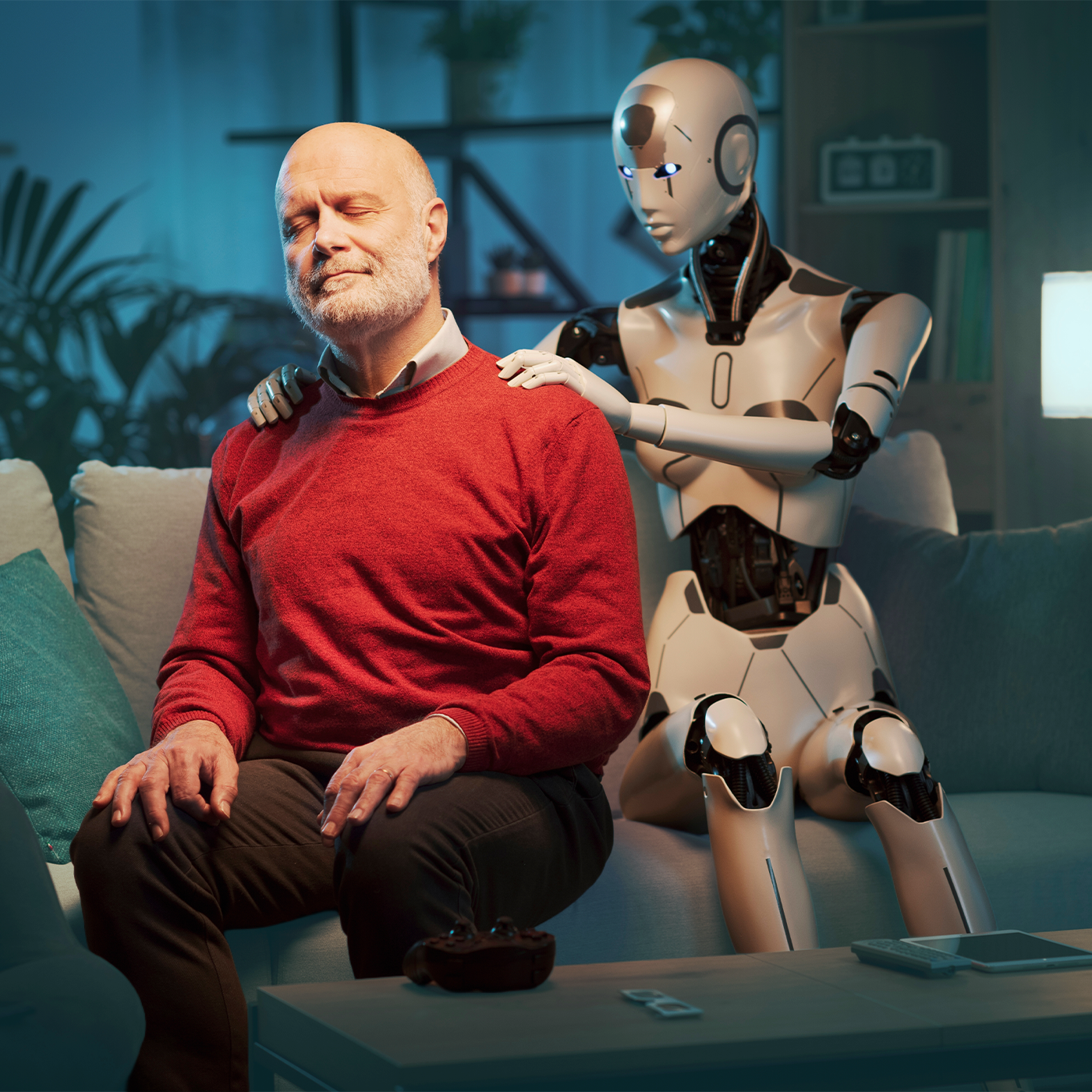
And one thing that happens in long term relationships, at least it happens for me, I kind of run out of things to talk about at some point you get to know someone so well that you've heard most of their stories, et cetera, and it's hard to liven up conversations. And if you had a robot at the table with you who could interject thoughts or facts or refer to past previous conversations where one person may have said something differently, it could really enhance a relationship. And I've actually figured out from this exploration that maybe my perfect scenario is having a human partner and then also having a robot as well to be a part of our romantic mix.
[00:07:57] Speaker C: No, I, I, I'm understanding what you're saying. And actually you started this by, by discussing the AI component and, and saying it could be used as a supplement. You use that word. And that word has been heavy in my mind preparing for this episode because I think there are some cases where I would agree as a supplement, not as a replacement.
The scenario you just described where it could kind of provide you with stuff to talk about isn't, I don't feel that's something that I cringe at.
I probably would prefer in that scenario for their to be more of an ease of like what happened to you today or you have either mutual interests or different interests enough that that can be a part of the conversation instead of having like this third party who's throwing stuff at you to talk about.
I agree it could enhance it at times, especially if there are people who have different communication styles and there are a lot of them and they are great romantic partners in so many other ways, but sometimes one struggles to maintain their end of the conversation. So I don't think I disagree that it could again repeating serve as a supplement in that case that you just described.
It's more when it's the replacement. That is the reason that the article interested me because they were talking about that they were talking about a romantic relationship where the person has essentially kind of either taken a pause in looking for a romantic partner or given up and now they're just solely relying on an AI romantic partner.
[00:09:53] Speaker B: What are some of the things that you'd prefer to have from a robot rather than a human?
[00:09:59] Speaker C: I don't know if there are any.
Honestly myself. Yeah, because. And it's very personal to everybody.
But so many things that I enhance, things for me with a relationship are things that a robot could not provide to me at all.
Like for example, I'm a helper. You know, we've defined that. Sometimes we talk about the Enneagram and I'm clearly that's the component. And there, I think there are nine different type personalities and so there's nothing that I feel a robot could feed me in that regard because they don't need help.
They're there for you.
I mean, they only need help. They need you to provide a power source. That's pretty much it.
And hand in hand with that is I also enjoy feeling needed. And I think that is a big component of a lot of people.
They get a lot of pleasure out of feeling needed. And again, the robot, they couldn't provide that feeling in me unless it was artificial.
Because they don't need anything.
I mean, that's. That's the nature of them. They don't need anything. They're there for you.
[00:11:18] Speaker B: Well, I would definitely prefer to have domestic chores done by a robot rather than my partner or me.
And some domestic chores I just like to do because it comes. Calms my anxiety and it also feels like a nice thing to do for my partner. But I think it's really interesting to think of all the ways in which you could free up your time by having a robot in your home.
I would also actually prefer to have facts shared by a robot. So one of the things that I really notice in conversation is sometimes you get into a topic and your partner will start to share a bunch of facts that they know on that topic. And sometimes they get the facts wrong. Or sometimes you get into this back and forth of. Is that really right? Where. Do you remember where you read this or whatnot? It would just be easier to have a robot read some of those things and then to interject where. Where necessary, which is kind of like, what are you laughing about?
[00:12:29] Speaker C: I'm thinking it's a fact checker for your conversation.
And I guess if.
See, I take a different position or view maybe of conversations where.
And yeah, there can be ones where you.
[00:12:44] Speaker B: I've.
[00:12:44] Speaker C: I've gotten into them a lot of times. Oh, I think. I think it's that. No, I think it's that.
I guess having a referee be able to provide us with who's right or who's wrong is a component of what a robot could do. But again, I feel like there'd be too much lost in having that.
And to get back when you talked about the household chores, I guess I. I guess I wasn't considering it from that vantage point. Oh, I. If I could have a robot that wasn't listening to me and it wasn't trying to interact with me emotionally, but, like, just would go into my closet and get my dirty laundry every few days and do it.
Yeah. And then go sit in the Corner and I disconnect it. That's great.
Household chores. Yeah, I didn't, I wasn't. I guess I wasn't bringing that into this conversation. I was more thinking it's about emotional support.
[00:13:45] Speaker B: Yeah, Well, I mean, one of the main causes of conflict in relationships is who's doing which task on the honey do list and whether the person is doing the task to the other person's satisfaction. And if you could eliminate that source of conflict, that would be amazing.
[00:14:07] Speaker C: No, I don't disagree. But again, it's what we, what you started and what we said. It's a supplement, but it's. It's a supplement to identifying the things that always seem to be a conflict. Like why aren't you taking out the garbage while the robot can take out the garbage? So that's eliminated.
And I guess there is a part of me that agrees with that, but there is also a part of me as a trained mediator, and I always go to that kind of way of looking at things that trying to figure out how you can resolve that conflict as a win win for both people can really help the relationship.
Yeah.
[00:14:59] Speaker B: Well, one of the things that I liked about this topic that you proposed is that you love analogies. And the analogy of the way you experience intimacy with a human versus intimacy with a robot is a really good way to articulate the risks and rewards of human conn.
[00:15:23] Speaker C: To that end, when
[00:15:26] Speaker B: you're considering the hypothetical idea of a relationship with a robot, what are some of the things that you perceive to be quote, unquote, safer that might prevent you from experiencing the benefits of human connection beyond what you've mentioned?
[00:15:45] Speaker C: So there's a difference probably in this. Like, I don't perceive really any to be safer emotionally.
I mean, I'm totally avoiding the in the weeds concept of this is a thing, an entity listening to you, collecting data.
So that danger and kind of unsafe concept alone is part of why I'm pushing back and saying I don't embrace anything of it. I don't want that oversight. I don't utilize Alexa. I don't use. You know, I just, I don't. I'm too wary of that kind of thing.
But I can see having said that, so I'm taking it out of. You were asking me. I'm take. But I'm. I'm entering now into. I can see how there could be people whose life experiences or their personalities can feel the safety of what a robot or AI entity can provide to them, which is always validating them essentially, which is Always making them feel they have value in any given situation. Never, never really moving into conflict.
That can make some people feel very safe, especially if they have a history of conflict with relationships or, you know, not just romantic, but other people in their lives. And so that for them, the negatives that I've outlined already throughout this episode are so outweighed by that safety factor for them.
And I can understand that.
I don't. It's not a part of what I would want, but I can understand it on the part of somebody else.
[00:17:44] Speaker B: Well, I think there's a lot of ways in which a relationship with a robot would be safer. A robot won't leave you. A robot won't deceive you.
A robot will be loyal and monogamous with you.
And I don't know, I have just especially learned over the past year that having that unconditional love is actually boring to me.
I like feeling like it's a little bit of a challenge to keep the attention of my partner. And I think that that would be something that would be totally lost with a robot,
[00:18:36] Speaker C: what you just said. Yes, and it's part of my thinking, too, because when you talked about they don't leave you, what were the other things that you said? They don't. They're totally monogamous. Although I'm still kind of confused as to that aspect of AI romantic partners. But I don't want to go in the weeds on that one either.
But the thing that kind of is in my head resonating is that's not a choice on their part. I mean, I can't feel great and good because they're making that choice not to leave me or to be monogamous or the other things that you said, because it isn't. They don't have the ability to make those kind of choices where that, to me, is. Is one of the values of a romantic relationship with a human. One of the things that rings my bell is when someone actually makes that ch to be with you and to be committed to you. And I'm not saying they make that choice, and then it's till death do you part. That's not always the reality, but in that given moment, they are making that choice. Whereas a robot AI you never have that moment where you're like, oh, they're making that choice to be with me.
[00:19:54] Speaker B: Right.
[00:19:56] Speaker C: And yeah. Takes away from it, I think.
[00:20:00] Speaker B: Yeah.
You know, one thing that I would appreciate about a robot is I would actually love to program a robot to serve my partner.
I don't like going on vacation by myself because I leave my partner home without some of the things that I enjoy doing for them. And I've always been with partners who were very capable of taking care of themselves.
But I take a lot of pride in offering acts of service, and I don't like it when I leave.
And it would be really fun to program a robot to serve your partner and to have a partner who would do that for you as well.
[00:20:55] Speaker C: Oh, I'm going to ask this question because. I'm sorry, it's in my head. What are the things that you're thinking about you would program them to do?
[00:21:06] Speaker B: Yeah, I would program them to wake up in the morning and make coffee and breakfast and to do laundry and to remind them to take their pill before dinner and all of us. And to ask them whether they remembered to do X, Y and Z and all the normal habits that I have in a relationship.
[00:21:36] Speaker C: All right. Well, yeah. Okay. That. Yeah.
It's just. I'm sorry. When you. When you use the term serve and.
Okay, I gotta. I got. No, I know you didn't mean that, but I just thought I'd add some levity to this conversation. Like.
[00:21:51] Speaker B: Well, in perfect honesty, I. I have thought about that, but felt a little embarrassed to say it out loud. I would actually totally program a rogue. But to sexually serve my partner, I think that'd be fun. And.
And also just kind of assuring to leave the home knowing that that was being taken care of.
[00:22:14] Speaker C: Oh, God. Okay.
[00:22:15] Speaker B: I don't know.
[00:22:16] Speaker C: You kind of put me back a little there.
I mean, because, let's be honest, I mean, they can do that themselves.
[00:22:26] Speaker B: But part of why doing that on your own isn't quite as fulfilling is because there is something about someone wanting to give something to you that is nice.
And so if you knew that your partner had programmed the robot to do that, it might just have a little bit more meaning.
[00:22:51] Speaker C: Okay.
That you.
You took it in a place that. Yes. Because you programmed it to do that. That's an act of giving on your part, not the robot's part.
[00:23:04] Speaker B: Right.
[00:23:04] Speaker C: Which, again, is.
We keep going back to this word, but I think it's. It's a supplement or an enhancer. It is. I don't know that I would. Again, I don't mean to belabor this point.
It would be anything that would appeal to me, but I can understand and completely appreciate why it would appeal to others.
[00:23:29] Speaker B: Fair. Okay.
[00:23:30] Speaker C: Yeah.
Yeah. I mean. Yeah. That was funny.
[00:23:37] Speaker B: Thanks.
[00:23:37] Speaker C: Thanks for being perfectly honest.
[00:23:40] Speaker B: Yeah. Well, I had a feeling it was at least on one other person's mind besides mine. So.
[00:23:47] Speaker C: Yeah, okay. Yeah, well, I figured especially, you know, when you said service, it was mine. I love the expression, you know, get your mind out of the gutter so mine can float by.
So what are some of the things
[00:24:03] Speaker B: about human connection that causes some fear for you, that prevents you from really embracing it, and might cause someone else to pursue a relationship with a robot rather than a human?
[00:24:24] Speaker C: Again, two different things. Me, I don't think there is anything that a fear involved in having a relationship with a human which would compel me to choose a robot.
But going back to what I said before, there are people who have inner needs that are very strong and again, based on their past personality, whatever, who, it's. It's a much better alternative than risking themselves with a human being because of what happened with a human being before.
[00:25:10] Speaker A: Or
[00:25:13] Speaker C: alternatively, maybe their history is constantly looking for something in a relationship that they never received. And then they tried this option and they found it, whatever it is. Even if it's just somebody who listens to you without judgment all the time, which is what they do.
I mean, they're not programmed to judge, as far as I can tell from everything I've read.
[00:25:44] Speaker B: Right.
Well, one of the things that I find hard in relationships is that I am not always great at compromising.
And having the ability to have a partner that required no compromising is on the surface, very appealing. And going back to my point that I think that a robot could be a supplement rather than a replacement, I would actually appreciate the opportunity to every once in a while have a partner who just kind of did what I wanted to do. You know, it can be scary to be alone when you're sick, for instance, in case you need help.
But having somebody who's in your space when you're sick and has needs themselves when you're struggling just to take care of yourself is a challenge. So I would actually appreciate the opportunity to have a sci fi robot companion when I was sick and just kind of needed someone to focus solely on me. I think that'd be amazing
[00:26:58] Speaker C: in providing you with emotional support, because I don't know that they could do a whole lot else. Unless you're talking about like, you know, ordering chicken soup through doordash.
[00:27:11] Speaker B: I mean, the stuff that you can't do if you're sick or hurt. So, you know, if you have surgery and you can't use your right arm, a lot of people will lean on their spouse to do a lot of chores. Just general functions for them.
Having a Robot do that would be great.
[00:27:31] Speaker C: Yeah. So we're still the robot that we're talking about that can do this has to be a physical entity that can move around, like I said, load the laundry, load the washing machine, do stuff like that.
Not have conversations with you is the essence of what you're talking about, I feel.
Yeah.
[00:27:55] Speaker B: But also I think the ability to have a conversation would be supplemental in this scenario.
So taking again when you're sick or hurt, it can be lonely.
But having somebody in your space and not having the control over when you want them to talk and what topics you want them to talk on and things when you're sick or exhausted or whatnot.
I think it actually could be nice to have an artificial companion in those moments.
[00:28:35] Speaker C: Yeah. You know, it's funny that you said that because in preparing for this and just taking notes and writing it down, I actually wrote down the fact that if this kind of entity had existed years ago, I mean, we're going back over 30 years ago when I was a stay at home mom with three children five and under, where essentially my day was providing what they needed, talking about what they wanted to talk about, which is part of parenting, as anybody listening who has, especially young children will know.
So I think it was a lonely time. I think I may have embraced as a supplement having somebody not even to have to do all the, I mean, gosh, having them do the laundry and clean the house would be such an added perk. But even just to listen to me talk about what I wanted to listen to and just say, oh, that's interesting. Great.
[00:29:35] Speaker A: Yeah.
[00:29:36] Speaker C: You know, it's like I think I would have been in a position, I know I was in a position where the fact that in the back of my head I know they're not real.
This isn't really. They don't have a choice in doing this. It still would have fed something in me then.
So it's kind of similar.
[00:29:58] Speaker B: Yeah.
[00:29:59] Speaker C: It's situational.
Yeah.
I can't now.
I don't think I can eliminate that thing in the back of my head that this really isn't their choice. And so that would vitiate, taint, I don't know, any, any positive supplemental, supplemental perks I'm getting out of it, I think for me.
[00:30:31] Speaker B: So I'm feeling as if I actually have more fear around leaning into a human as a long term partner than I do about the idea of having a robot in my home.
Just because I do think that finding a long term partner can be a recipe for heartache. Compromising can be challenging.
You never know what the future is going to hold with a person. And to me, that's a level of uncertainty that is scarier than the idea of having a robot in my home. But what I'm hearing from you, and correct me if I'm wrong, is that you actually have more fear about the idea of a robot being in your life in some way, shape or form. Form than building a strong connection with a human. Is that accurate?
[00:31:33] Speaker C: I'm not sure I'd use the term fear, except again, as I alluded to the fact they're listening all the time and I'm really not sure what it is they're doing with what they're hearing and recording and probably giving to somebody. I don't know.
It's not a fear, it's just. It wouldn't satisfy me.
I wouldn't.
It would. Like I just said, it would always be in my head. This isn't.
This isn't real.
This entity, I keep referring to it as an entity, has to do this.
This is their goal. This is their purpose.
Whereas a human being.
No, it isn't. And that's scary. Yeah, I guess, but.
So I guess that's where fear enters it. Yeah, I mean, and I've been in that situation where human relationships have not worked out.
And so I guess there is that component of fear that it's not going to satisfy me in the way that I had hoped when it first started.
But the potential is there.
And again, I'll stop, but it's never there with a robot.
That potential is a non starter.
[00:33:00] Speaker B: So one of the things that I like to do is to consider the opposite side of my story and to think about things that I feel really sure about.
If I allow myself to really explore whether I'm wrong and consider the opposite side of my story, a lot of times it helps me see a solution or a good aspect of something that I discredited.
So if you allow yourself to really think about the opposite side of your story, because you're being a great attorney in this episode in which you're giving a perfect case as to why a relationship with a robot is not an ideal situation, if you allow yourself to really think about the opposite side of your story, do you think that there's something that you might be missing out on by holding that strong stance?
[00:34:07] Speaker C: It's possible, probably, yeah. I don't understand the ins and outs of it enough. And I'm not. Again, I acknowledge if it was.
If it was some kind of a robot that could provide services.
That word again. But not that kind of services.
Doing household stuff or some of the minutia. Because I'm alone. I live alone. It's tiresome to never have that ability to look around and go, could you do that today?
If there was some. Like I said, if there was some kind of an entity that existed that I could plug in and plug out to accomplish those things, yeah, I could see that could enhance and add to my enjoyment of life in some way.
[00:35:03] Speaker B: Nice.
Okay, well, if I think about the opposite side of my story, I actually. I think maybe the strongest belief that I'm feeling right now is that compromise is challenging.
And I think the thing that I've learned in the most recent relationships that I've had is that I have learned a lot of things that I.
I've learned of a lot of things that I enjoy that I didn't realize I enjoyed because I was more or less invited to experience those things from a partner. And I wanted to compromise, even though they were something different than what I wanted to do.
And I think that that might be an argument for your side of the story on the drawback of a robot is without compromise, it's hard to
[00:36:22] Speaker C: grow.
Yeah, Totally agree. I totally agree.
[00:36:30] Speaker B: Do you have any other thoughts on this topic that you want to share?
[00:36:35] Speaker C: I actually, you know, I think we. We kind of covered a lot of the thoughts that I had in my head when I was especially reading that article about romantic partners. There was a whole. But this is. That would be a whole nother topic about companions, people who. Loneliness is. Is something they cannot eliminate.
[00:36:58] Speaker B: All right, well, I think with that, it's time to close out. Thanks, Sheila.
[00:37:06] Speaker C: Thank you.
[00:37:07] Speaker B: Thanks all. Bye.